

If I want top meat at home in Dubai, I check three things first: source, chill on delivery, and cut choice. If any one is off, even an order that costs AED 200+ can disappoint.
Here’s the short version:
- Buy from a seller that shows the source clearly: country, breed, halal status, and ageing time
- Check delivery temperature: meat should arrive chilled, ideally below 5°C
- Inspect the meat at the door: colour, smell, marbling, trimming, and use-by date
- Match the cut to the meal: ribeye and striploin for grilling, lamb leg and rib roast for roasting, fillet for pan-searing
- Store it right: keep it at 0–5°C and cook dry-aged beef soon after delivery
A few numbers matter here. Dry-aged beef is often aged for 45 to 90+ days. A good steak should keep about 0.5–1 cm of fat cap. For steak, 55°C is a solid target for medium-rare. And for serving sizes, I’d allow around 200 g to 500 g per person, depending on the cut and the meal.
What this means is simple: don’t judge “premium” by the label alone. I’d judge it by what the seller tells me before I buy and what I see the moment the box arrives.
The article below walks through exactly how I’d do that in Dubai, with halal checks built in.
How to choose a premium meat delivery service in Dubai
Check sourcing, traceability, and halal information
Before you place an order, read the product page closely. A supplier you can trust should clearly state the country of origin, breed, farming method, and halal status. You want more than vague labels like "premium beef" or "imported lamb."
Named origins matter. If you see sources such as Mayura Station or Miyazakigyu, you know exactly what you're buying. For beef, check the ageing details too. If it's dry-aged, the listing should say how long. A serious butcher will usually state a range of 45 to 90+ days.
Look for butchery standards and cold-chain delivery
Even portioning is one of the clearest signs of proper butchery. Steaks cut to the same thickness cook more evenly, and neat trimming helps you get the same result each time.
Delivery matters just as much. Premium meat should arrive chilled, sealed, and packed to hold its temperature until it reaches your door. In practical terms, it should arrive below 5°C. If a supplier doesn't explain this on its website, that's worth noting before you spend on a premium cut. Once that part checks out, judge the meat the moment it arrives.
Use Fin & Bone as the buying benchmark
Those same checks show up clearly at Fin & Bone in Al Barari, Dubai. The butcher focuses on traceable, responsibly sourced meat, with beef dry-aged in-house for 45 to 90+ days under the direction of Head Butcher Richard Douglas, formerly of The Lana, Dorchester Collection.
Named sourcing, clear halal information, stated ageing periods, and skilled butchery - that's the benchmark. If you're comparing premium meat delivery services in Dubai, those are the points to measure before deciding whether the box on your doorstep is worth cooking tonight.
sbb-itb-3031837
How to check premium meat when it arrives
Check the order as soon as it arrives. The packaging should feel cold, stay sealed, and look dry. You should also see a clear use-by date and a halal label. This is where you confirm you got the quality you paid for.
Once the box passes that first check, look at the meat itself.
Freshness signs for beef, lamb, and poultry
Fresh beef should have a deep red to maroon colour, feel firm, and smell neutral. Lamb should range from pale pink, if it’s milk-fed, to cherry red, with bright white fat and no strong odour. Poultry should look plump and feel slightly moist, not wet or slippery. It should also have a clean, neutral smell, with no discolouration around the joints.
Also check that the label matches your order and that the use-by date is easy to spot.
| Meat Type | Freshness Signs | Red Flags |
|---|---|---|
| Beef (dry-aged) | Deep red/maroon, firm, nutty aroma | Slimy surface, grey tint, sour or ammonia smell |
| Lamb | Pale pink to cherry red, white fat, neutral scent | Brownish meat, sticky surface, strong off-odour |
| Poultry | Plump, slightly moist skin, neutral smell | Grey or greenish hue, excess liquid in bag, sulphur smell |
Premium cuts need a bit more attention.
What to look for in wagyu and dry-aged beef
With wagyu, check the marbling first. It should be fine and spread evenly through the muscle. The fat should look creamy white, not yellow. Yellowing points to poor quality. The meat should also feel firm, not soft or mushy.
Dry-aged beef will look darker, with a deeper red colour. That’s normal. What matters more is the smell. It should be nutty, not sour. A sour odour means spoilage, not ageing.
How portioning and trimming affect cooking results
The last check is about how the cut will cook. Shape matters more than many people think. If one end is thick and the other is thin, the steak won’t cook evenly. Excess silver skin and heavy gristle should be trimmed away because they affect texture on the plate.
A good cut should keep about 0.5–1 cm of fat cap for flavour and moisture.
| Butchery Quality | Well-Butchered Steak | Poorly Cut Steak |
|---|---|---|
| Thickness | Uniform throughout for even cooking | Tapered or uneven edges |
| Trimming | Silver skin and heavy gristle removed | Excess connective tissue left on |
| Fat retention | Balanced fat cap (~0.5–1 cm) | Over-trimmed (dry) or excessively fatty |
| Surface | Clean, smooth knife cuts | Ragged or stepped edges |
Butchery quality affects doneness, moisture, and texture. If the cut arrives with jagged edges, uneven thickness, or large patches of gristle, it hasn’t met the standard you paid for. Once the meat passes inspection, match the cut to the meal you plan to cook.
Match the cut to the meal you plan to cook
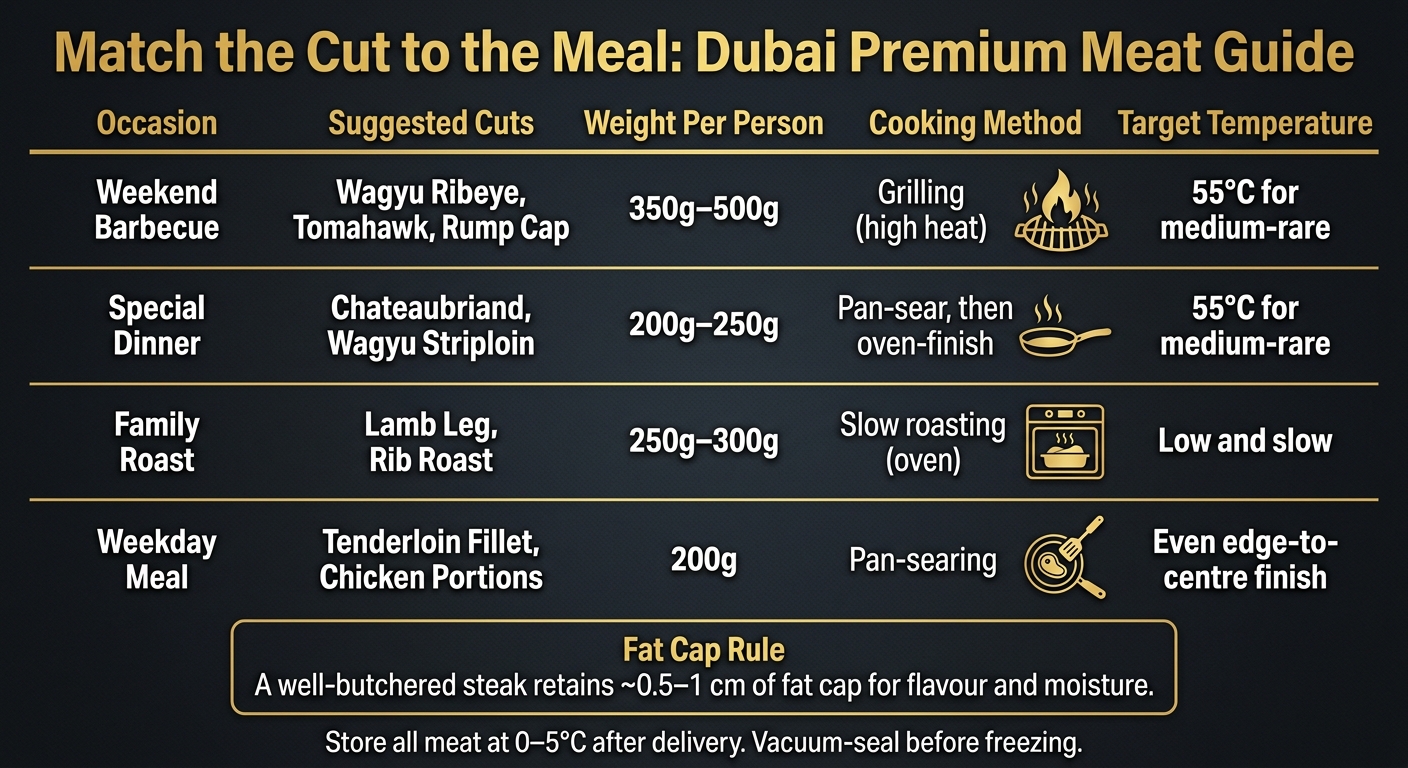
Premium Meat Delivery Dubai: Cut-by-Cut Guide to Grilling, Roasting & Pan-Searing
Once the meat passes inspection, the next step is simple: match the cut to the dish you want to make. Pick the cut for the cooking method, not the other way around.
Best cuts for grilling, roasting, and pan-searing
For grilling, cuts with plenty of marbling tend to do best over direct, high heat. A Wagyu ribeye or striploin from Mayura Station (Australia) or Miyazakigyu (Japan) works especially well. A Tomahawk or Rump Cap is also a solid pick for a weekend barbecue. For medium-rare steaks, aim for an internal temperature of 55°C so the fat stays rich and juicy.
For roasting, larger bone-in joints make more sense. A milk-fed Spanish lamb leg or grass-fed UK rib roast suits slow oven cooking and can feed the table with ease. These cuts need time and gentle heat, so it helps to plan ahead.
For pan-searing, leaner and more even cuts give you better control in the pan. A beef tenderloin fillet, striploin, or heritage-breed chicken portions are ideal. Sear over high heat, then finish in the oven so the cooking stays even from edge to centre.
How much to order per person
| Occasion | Suggested Cuts | Weight per Person | Cooking Method |
|---|---|---|---|
| Weekend Barbecue | Wagyu Ribeye, Tomahawk, Rump Cap | 350g – 500g | Grilling (high heat) |
| Special Dinner | Chateaubriand, Wagyu Striploin | 200g – 250g | Pan-sear, then oven-finish |
| Family Roast | Lamb Leg, Rib Roast | 250g – 300g | Slow roasting (oven) |
| Weekday Meal | Tenderloin Fillet, Chicken Portions | 200g | Pan-searing |
Storage after delivery and when to cook
After unpacking, keep the meat at 0–5°C until you're ready to cook. Dry-aged steaks are best cooked promptly, while the flavour is at its peak. If you need to freeze the meat, vacuum-seal it first to help avoid freezer burn and protect the texture.
Once the cut and portion line up with the meal, the last thing to check is whether the order still feels worth the price.
Conclusion: How to order meat that is worth the price
Getting restaurant-quality meat at home in Dubai comes down to three decisions, made in the right order: who you buy from, how you inspect the meat on arrival, and which cut you choose for the meal.
Get those three right, and the price makes sense. Miss even one, and an expensive cut can still let you down.
Start with the seller. Sourcing and cold-chain handling shape whether the meat arrives the way it should. Go with suppliers that clearly state the origin, breed, halal status, and ageing details, and that keep the meat chilled from dispatch to delivery.
Then check the box as soon as it arrives. Look at the marbling, trimming, and smell. Fin & Bone reflects these standards through transparent sourcing, skilled butchery, and chilled delivery in Dubai.
Once the meat passes that check, cook it the way the cut is meant to be cooked. Order with clear sourcing, inspect on arrival, and choose the right cut for the dish.
FAQs
How do I know if delivered meat stayed cold enough?
Choose a service that uses temperature-controlled delivery across Dubai and follows strict hygiene and food safety standards from preparation right to your door.
When your order arrives, refrigerate or freeze it promptly. Don’t leave packages at room temperature, as any spoilage caused by delayed storage after delivery is your responsibility.
Can I freeze premium meat without ruining its quality?
Yes, if you handle it properly. Refrigerate or freeze your meat soon after delivery to help keep its quality in good shape.
Storage is your responsibility. Good hygiene and food safety on arrival help preserve the natural flavour and texture of premium cuts for later meals.
Which premium cut is best for a home barbecue?
The best cut comes down to the flavour and texture you like most. Tomahawk and Rib Eye work especially well on the grill, with rich marbling and a tender bite.
If you want a bit more range, house-made sausages and kebabs are also ready for easy, restaurant-quality outdoor cooking. Expert butchers can also help with cut selection, seasoning, and cooking temperatures.


