

Grilling Scottish salmon is easier than you think. Here's the secret: start with high-quality, skin-on fillets, preheat your grill to the right temperature, and use simple techniques to avoid sticking and overcooking. Scottish salmon, raised in the cold waters of the North Atlantic, offers a rich flavour and firm texture that holds up beautifully on the grill.
Key Tips for Perfect Results:
- Choose the Right Fillet: Go for centre-cut, skin-on fillets with a bright pink hue and firm texture.
- Prepare Properly: Pat the fish dry, bring it to room temperature, and coat it lightly with oil.
- Set Up Your Grill: Preheat to 218–230°C, clean and oil the grates, and use a two-zone setup for better heat control.
- Grill Skin-Side Down: Cook for 6–8 minutes without moving the fillet, then flip for 2–4 minutes.
- Monitor Temperature: Use a thermometer to ensure the salmon reaches 52–54°C for medium-rare.
Scottish salmon’s natural fat ensures it stays moist and flaky, but precision is key. Follow these steps, and you’ll have perfectly grilled salmon every time.
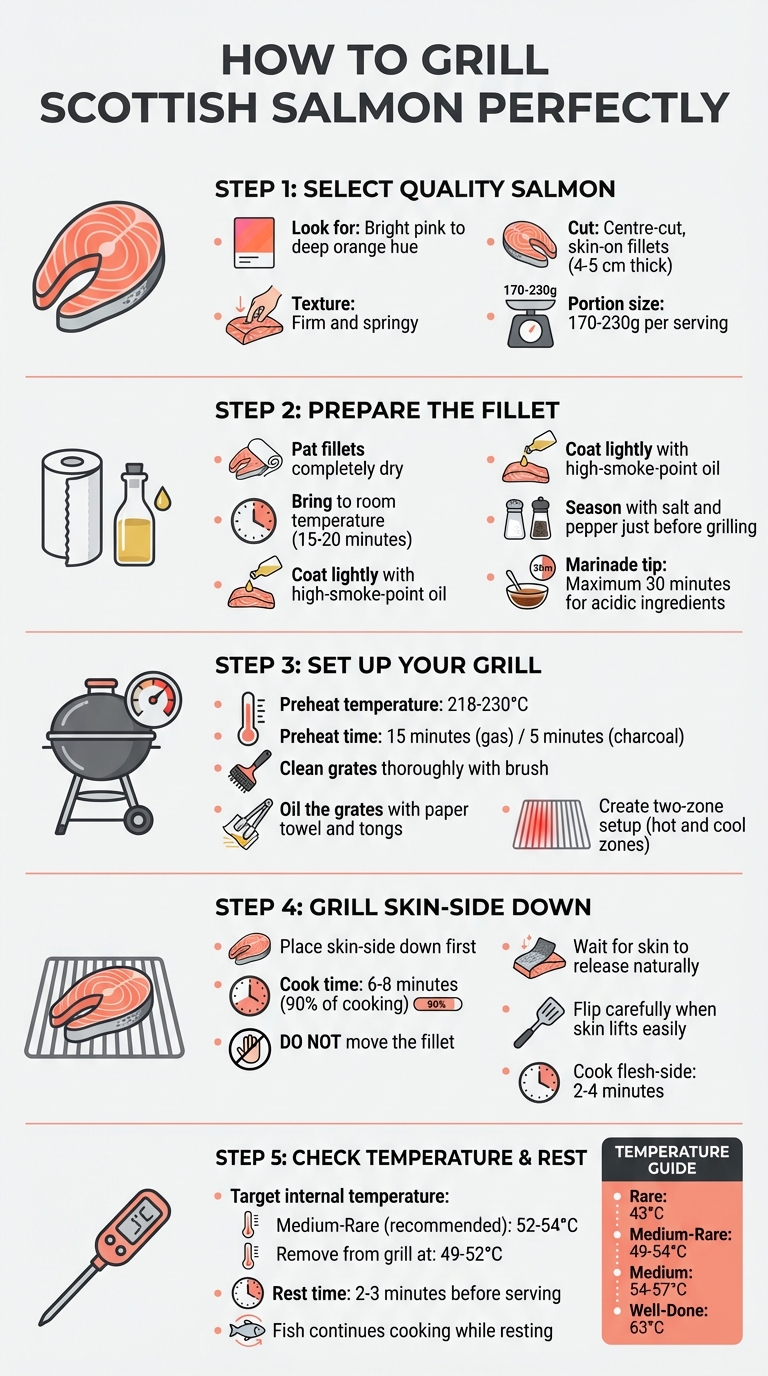
Step-by-Step Guide to Grilling Scottish Salmon Perfectly
Selecting and Preparing Scottish Salmon
How to Choose Quality Scottish Salmon
Getting the best results on the grill starts with picking the right salmon. Look for fillets with a bright pink to deep orange hue and firm, springy texture - signs of healthy omega-3 levels and responsible farming. Avoid any fillets that feel soft or leave a dent when pressed.
Fresh Scottish salmon should have a clean, mild scent reminiscent of the ocean. A strong or overly "fishy" smell is a red flag. Check for flesh that looks moist and slightly glossy, without any dull or dry patches.
Traceability is essential when choosing premium salmon. At Fin & Bone, for instance, seafood is flown in weekly from the UK, ensuring you're getting salmon from the cold, fast-moving waters of the Scottish Highlands. These pristine conditions, combined with low-density farming and strict standards, result in exceptional fish.
For grilling, opt for centre-cut fillets rather than tail portions. Centre cuts, typically 4–5 cm thick, cook more evenly and are less likely to dry out. Always go for skin-on fillets - the skin acts as a protective barrier, keeping the fish intact and shielding it from direct heat.
Preparing Your Salmon for the Grill
Once you've got your quality Scottish salmon, preparation is the next step to grilling perfection. Start by patting the fillets dry with paper towels. Excess moisture can create steam, making it harder to achieve that golden crust.
If you're using frozen salmon, thaw it overnight in the refrigerator to preserve its texture. After thawing, dry the fillets thoroughly and cut larger pieces into individual portions of about 170–230 g - this makes them easier to handle on the grill.
Before grilling, let the salmon sit at room temperature for 15–20 minutes. Placing cold fish on a hot grill can lead to uneven cooking and increase the chance of sticking. During this time, lightly coat the fish with a neutral, high-smoke-point oil like grapeseed or vegetable oil. Applying the oil directly to the fish rather than the grill grates ensures better results.
Season the salmon with salt and pepper just before grilling to keep it juicy. If you're planning to use a marinade with acidic ingredients like lemon or vinegar, keep the marinating time under 30 minutes. Longer exposure to acid can break down the proteins, leaving the fish with a mushy texture.
sbb-itb-3031837
Setting Up Your Grill
Preheating and Cleaning the Grill
Getting your grill to the right temperature is the first step to ensuring your salmon doesn’t stick. For a gas grill, close the lid and preheat it for about 15 minutes at 218–230°C. If you're using a charcoal grill, wait about 5 minutes after arranging the hot, ash-covered coals before cleaning the grates.
Once your grill is hot, cleaning the grates is non-negotiable. Any leftover carbonised bits can create sticky spots that might tear the salmon’s delicate flesh. Use a sturdy grill brush with a long handle to scrape the grates clean. No brush? No problem. A crumpled ball of aluminium foil held with tongs works just as well, or try rubbing a halved onion over the grates - the moisture and acidity help loosen burnt-on residue.
"It only takes five minutes, but it makes all the difference between grilling glory and a mangled mess." - Leah Colins, Senior Culinary Editor, Serious Eats
Oiling the Grates
After cleaning, the next step is oiling the grates to create a non-stick surface. Take a folded paper towel, dip it in a high-smoke-point oil like grapeseed, vegetable, or canola, and use tongs to lightly coat the hot grates. Be cautious not to overdo it - excess oil can drip and cause flare-ups.
Gas vs Charcoal Grills
Choosing between a gas and a charcoal grill comes down to preference and the kind of flavour you’re after. Charcoal grills deliver intense heat and a smoky aroma that comes from the burning coals, making them perfect for a charred crust on your salmon. However, they require a bit more skill to manage heat zones effectively. Gas grills, on the other hand, offer consistent, adjustable heat with the turn of a knob, making it easier to avoid overcooking and maintain the salmon’s delicate texture. Plus, they’re generally simpler to clean.
Whichever type of grill you use, setting up a two-zone cooking area is a smart move. For a gas grill, turn off one section of the burners. On a charcoal grill, pile the coals on one side. This creates a cooler zone where you can move the salmon if it starts browning too quickly or if flare-ups occur.
"If you love that smoky, classic BBQ flavour, charcoal is the way to go. If you want quick, easy, and consistent results, gas is a great choice." - Frank's Butcher Shop
Mastering this setup makes it easier to control heat and ensures your salmon cooks beautifully every time.
Grilling Technique Step-by-Step
With your grill prepped and ready, it’s time to focus on nailing the grilling process.
Starting Skin-Side Down
By now, your salmon fillets should be at room temperature. Make sure both sides are thoroughly dried to help prevent sticking, and keep them lightly coated with neutral oil.
Always begin grilling with the salmon skin-side down. The skin acts as a protective layer, shielding the delicate flesh from intense heat and helping the fillet stay intact. For a fillet that’s about 2.5 centimetres thick, keep it skin-side down for 6–8 minutes - this accounts for roughly 90% of the cooking time. Resist the urge to move it around; the skin needs time to crisp up and naturally release from the grill.
"The skin isn't just there for looks - it's your best ally on the grill. It acts like a natural barrier between the delicate flesh and the hot grates, helping prevent sticking and holding the fillet together." - Kyle Lee, Captain, Alaskan Salmon Company
Flipping and Finishing
You’ll know it’s time to flip the salmon when the skin has browned and easily lifts off the grates. If it’s still sticking, give it a little more time to release naturally. Once the skin comes away with ease, carefully flip the fillet, using a tool to support it and avoid breaking the structure.
After flipping, the salmon only needs another 2–4 minutes to finish cooking. If you notice the exterior browning too quickly while the centre stays undercooked, move the fillet to a cooler part of the grill to cook more gently.
Using a Meat Thermometer
To ensure perfect doneness, use an instant-read thermometer. Insert it into the thickest part of the fillet. For a moist, silky texture with a slightly translucent centre, aim for an internal temperature of 52–54°C. Remove the salmon from the grill once it reaches 49–52°C, as it will continue to cook as it rests. Let it rest for 2–3 minutes before serving to allow the juices to redistribute.
| Doneness Level | Internal Temperature |
|---|---|
| Rare | 43°C |
| Medium-Rare | 49–54°C |
| Medium | 54–57°C |
| Well-Done (USDA) | 63°C |
Solving Common Grilling Problems
Getting your grilled Scottish salmon just right involves more than preparation and grill setup. Even with the best techniques, a few challenges can pop up. Here’s how to address the most common grilling issues to ensure consistent, delicious results.
Preventing Sticking
Sticking happens when moisture meets hot metal. To avoid this, make sure both the salmon and grill grates are dry. Brush them with a thin layer of high-smoke-point oil, and add salt right before grilling to keep moisture at bay.
If your fillet does stick, don’t panic. Give it an extra minute to form a crisp sear, which should help it release naturally. Instead of forcing a spatula underneath (which could tear the skin), use a carving fork or culinary tweezers to gently lift the fish from between the grates.
"Properly preparing the grill by cleaning and oiling the grill grate reduces the chances the fish will stick." - Daniel Gritzer, Editorial Director, Serious Eats
Of course, preventing sticking isn’t the only challenge. Managing heat is just as important for perfect salmon.
Avoiding Overcooking
Salmon cooks fast, and going beyond 54°C (130°F) can dry it out. Watch for white albumen (a sign of overcooking) and monitor the internal temperature closely. Remember, the fish will keep cooking even after it’s off the grill, so aim to pull it just before it hits 54°C.
Avoid marinating salmon in acidic ingredients like lemon or vinegar for longer than 30 minutes. Acids can start "cooking" the proteins, resulting in a mushy texture. While Scottish salmon’s natural fat offers some protection against drying, precise temperature control is still key.
"Salmon cooks quickly; going beyond 130°F can dry it out and ruin that tender, flaky texture." - Kyle Lee, Captain, Alaskan Salmon Company
Achieving consistent heat distribution is the final piece of the puzzle.
Ensuring Even Cooking
Uniform thickness is essential for even cooking, which is why centre-cut fillets are your best bet. These cuts offer consistent thickness, making the cooking process more predictable. For large fillets, portion them into 170–225 g pieces to ensure each cooks evenly.
If the outside of your salmon browns too quickly while the centre remains undercooked, move it to a cooler section of the grill to finish cooking gently. Keep the grill lid closed to maintain even heat circulation.
"If you do run into a situation where your fish risks burning on the outside before it's reached its final internal temperature, move it to the cooler side of the grill to finish cooking." - Daniel Gritzer, Editorial Director, Serious Eats
Grilling Scottish Salmon: Key Takeaways
Cooking Scottish salmon on the grill is all about mastering a few simple but important techniques. Start with high-quality fillets, which naturally hold up well to the grill's heat. A little preparation, like oiling the grates and the fish, ensures a perfect sear without sticking.
Temperature control is your best friend. Preheat the grill to 232°C–260°C (450°F–500°F), and cook the salmon skin-side down for 6–8 minutes. Aim to remove it from the grill when it reaches 52°C–54°C (125°F–130°F). Let it rest for 2–3 minutes, allowing the residual heat to bring it to perfection.
Scottish salmon’s rich fat content and firm texture make it ideal for grilling, but precision is still key. Using a meat thermometer and following these steps will help you achieve consistently great results.
To make the most of your grilling experience, consider sourcing your fish from Fin & Bone. They offer premium Scottish salmon that’s sustainably sourced, ensuring exceptional flavour and ethical practices. With fresh deliveries from Japan and the UK, their Al Barari store in Dubai (or online delivery) makes it easy to get top-quality seafood that enhances every bite.
Armed with these tips, you’re all set to grill Scottish salmon that’s tender, flaky, and bursting with flavour.
FAQs
How do I know my salmon is ready to flip without it breaking?
When grilling salmon, you'll know it's time to flip when the fish releases effortlessly from the grill. This is a sign that it has developed a good sear and isn't sticking. Generally, this process takes about 6 to 8 minutes for the first side. Resist the urge to flip too soon - forcing it can cause the salmon to fall apart. Once it lifts off easily, you're good to turn it over.
What’s the best way to grill salmon if I don’t have a thermometer?
If you don’t have a thermometer, you can still check if your salmon is cooked by focusing on its texture and appearance. Properly cooked salmon will have moist, flaky flesh with a slight sheen. Gently press it with tongs or a fork - it should offer a bit of resistance but shouldn’t feel overly firm or dry. These simple visual and tactile cues can help you achieve perfectly cooked salmon without risking overcooking.
Can I grill Scottish salmon in foil and still get a nice crust?
Grilling Scottish salmon in foil can absolutely give you a nice crust. Start by placing the salmon skin-side down directly on the grill or on the foil. This helps crisp up the skin and boosts the flavour. To get the best texture, try finishing the cooking process uncovered or take the salmon out of the foil in the final minutes. This way, you combine the convenience of foil grilling with the satisfying crust you're aiming for.


