

If the counter smells sour, the ice is melting into puddles, or the staff can’t tell me where the fish came from, I don’t buy it. That one rule saves me money, cuts waste, and lowers the chance of taking home seafood that won’t cook well.
Here’s the short version: I check the display, the fish, the shellfish, and the seller. For whole fish, I look for clear eyes, red gills, and flesh that springs back. For shrimp, I avoid slime, black spots, and cloudy liquid. For oysters, I buy only closed, heavy shells kept at 0–4°C, and I check the harvest tag. In Dubai, where summer heat can hit 40°C, cold storage and clean handling matter from the first look to the final payment.
My quick checklist:
- Smell: clean and sea-like, never sour or ammonia-like
- Ice: thick, clean, with no pooled meltwater
- Whole fish: bright eyes, red gills, shiny skin, firm flesh
- Fillets: moist, dense, no browning or splitting
- Shrimp: translucent, shiny, no slime, no sour smell
- Oysters: closed, heavy, cold, tagged, used within 7 days of harvest
- Seller: can answer where it came from, when it arrived, and if it was frozen before
I also ask direct questions before I pay. If I’m buying Hamour, I may ask about Suman grade (2–4 kg) because it can give about 30% more usable meat than smaller fish. If I want other options, I can ask for Shari, Jesh, or Twin bar Seabream.
This gives me a simple way to judge seafood at the counter without guesswork.
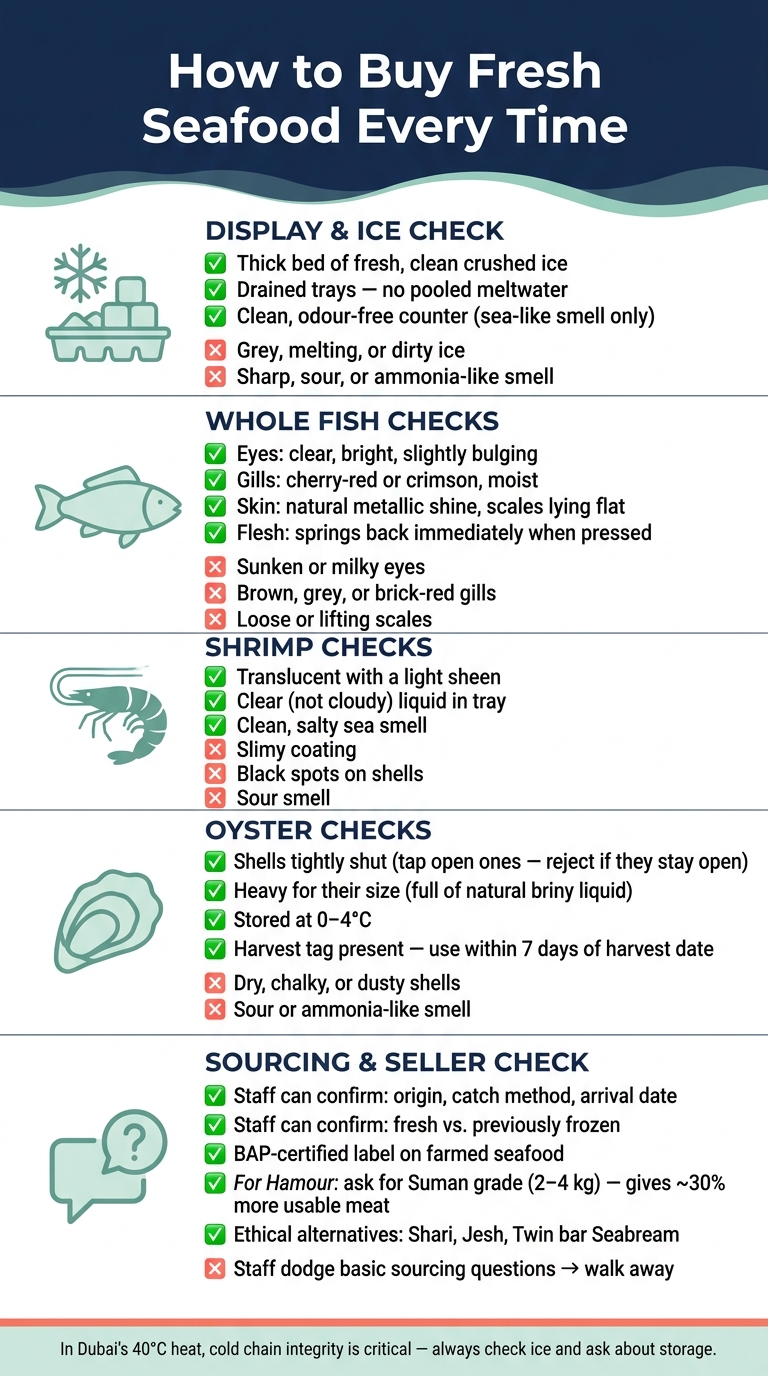
How to Buy Fresh Seafood: The Ultimate Fishmonger Checklist
Start at the display: first checks before looking closely
Before you pick up a single fish, the counter already gives you plenty to work with. In a well-run fishmonger shop in Dubai, surfaces are clean, tools are in order, and different species are kept apart. That separation isn't just neat-looking. It helps prevent cross-contamination and shows the seller is paying attention to basic food hygiene.
What a well-kept fish counter should look and smell like
Smell is one of the fastest checks. A fresh counter should smell clean and sea-like, not fishy or sour. It should never smell sharp, sour, or ammonia-like.
Ice matters too. Fish should sit on a thick bed of fresh, clean ice, or stay in a clean refrigerated case. In Dubai's heat, drainage matters even more, so check for drained trays that stop meltwater from pooling underneath. Fillets should look moist and firm, with no browned or discoloured edges.
Those simple checks help you rule out bad displays before you inspect each fish up close.
Warning signs to spot before you buy
If you can smell the counter before you even reach it, that's reason enough to walk away. Any sharp, sour, or ammonia-like odour can mean spoilage is already starting. And yes, one bad item can affect the fish around it.
Visually, look for fish that holds its shape. Fresh fish looks firm, not limp. If a fish isn't fresh, it starts to sag and can take the shape of whatever it's lying on. Soft fish, dull or greyish skin, cloudy eyes, or excess slime are all clear warning signs.
The same goes for shellfish. Oyster shells that look dry or dull have likely been sitting out too long.
If the display passes these checks, move on to the fish itself.
sbb-itb-3031837
How to check whole fish and fillets
Once the display passes the smell and ice check, look at the fish itself. You don’t need tools or training for this. Just use your eyes, nose, and fingertips.
Whole fish checks: eyes, gills, skin, scales, and firmness
Start with the eyes. They should look clear, bright, and slightly bulging. If the eyes are sunken or milky, that’s a strong sign the fish has been sitting there too long.
Then lift the gill cover. Fresh gills should be cherry-red or crimson and still moist. If they’ve turned brown, grey, or brick-red, the fish is older than you want.
Now check the skin. It should have a natural shine, almost metallic, and reflect light evenly. The scales should lie flat and stick tightly to the body. If they’re loose or lifting, that usually means the fish has been stored too long.
Press the thickest part of the flesh with your thumb. Fresh fish should spring back almost at once. If your fingerprint stays there, it’s past its best.
If you’re buying a gutted fish, inspect the cavity too. Look for any soft flesh, discolouration, or residue.
How to assess salmon, hammour, and sea bass in-store
Different fish show age in slightly different ways. That’s why small visual changes matter, especially for fish commonly sold in Dubai.
Salmon fillets should hold their shape well, with no gaping between the muscle layers. The colour should be even, and the cut edges should look moist and dense, not dry or starting to separate.
Hammour (Brown-Spotted Reef Cod) should have clear brown spots and firm skin. If the skin looks dull or grey, leave it. For whole hammour, go for fish that are firm and well-shaped, with cherry-red gills and no soft patches near the belly.
Sea bass should have bright, clear eyes and cherry-red gills if you’re buying it whole. The flesh should look dense and moist, with no dull areas or sagging.
| Species | Key freshness check | Watch out for |
|---|---|---|
| Salmon | Firm fillet, no gaping, consistent colour | Dry or separating edges |
| Hammour | Clear brown spots, firm skin, cherry-red gills | Dull or grey skin |
| Sea bass | Bright eyes, dense moist flesh | Soft or sagging flesh |
The same kind of close check matters for shellfish too. Shrimp and oysters each have their own signs to inspect at the counter.
How to check shrimp and oysters
Shellfish need a slightly different check. You’re looking for clear liquid, live shells, and that clean, salty sea smell. Nothing should seem murky, sticky, or off.
Shrimp checks: colour, texture, and smell
Fresh shrimp should look translucent with a light sheen. If they’re packed in a tray, the liquid should be clear, not cloudy.
Skip shrimp that show any of these signs:
- A slimy coating
- Black spots on the shells
- A sour smell
Good shrimp should look clean and moist, not dull or sticky.
Oyster checks: shell condition, weight, cold storage, and smell
Only buy live oysters. The shells should be shut. If one is slightly open, tap it. If it stays open, reject it.
Pick up the oyster too. It should feel heavy for its size because it still has its natural briny liquid inside. The shell should look dark and damp, not dusty or chalky.
Smell matters here as well. Oysters should smell clean and sea-like, not sour or ammonia-like. If an oyster smells off or looks dry inside, reject it.
Buy oysters only from a clean iced display or refrigerated case at 0–4°C. Check the harvest tag for the origin, harvest date, and shipment date. As a general guide, bivalves are best used within 7 days of the harvest date. The harvest tag helps confirm both origin and freshness.
Assess handling and ask about sourcing before you buy
Freshness tells you what seafood is like right now. Handling tells you how long it will stay that way.
A fish can look perfect at first glance and still lose quality fast if the cold chain breaks anywhere between the catch and the counter. In Dubai’s 40°C heat, that matters a lot. Once seafood warms up, the flesh can dry out and you often get less usable meat.
Good handling signs versus warning signs at the counter
The counter can tell you plenty before you even speak to anyone. A quick look often separates a careful seller from a careless one.
| Feature | Good Handling Signs | Warning Signs |
|---|---|---|
| Ice Condition | Thick bed of fresh, clean, crushed ice; fish on perforated trays or in a refrigerated case | Grey, melting, or dirty ice; fish submerged in pooled water |
| Drainage | Meltwater drains away from the fish | Fish sitting in meltwater that can affect flavour |
| Tools & Hygiene | Sharp, specialised knives; clean, visible workspaces | Dull knives that tear flesh; cluttered or dirty surfaces |
| Staff Knowledge | Can explain origin, catch method, arrival time, and whether it was previously frozen | Can't answer basic questions about sourcing or handling |
If the fish is sitting in water instead of resting on ice, that’s a bad sign. It can affect flavour and texture. And if the staff dodge simple questions, that tells you something too.
Traceability, ethics, and making the final call
Once the counter looks good, check the source before you pay. Be direct.
Ask:
- Is this fresh or previously frozen?
- Where was it caught?
- When did it arrive?
If you want a more responsible option, ask for Shari, Jesh, or Twin bar Seabream instead of species under heavier pressure, such as Kingfish or Hamour.
If you are buying Hamour, ask if it is Suman grade (2–4 kg). That size gives about 30% more usable meat than smaller fish, which can make it a better buy per edible gram.
Sourcing matters as well. Look for BAP-certified labels on farmed seafood, and ask if the species is in breeding season. For shellfish, ask to see the tag with the harvest location, harvest date, and shipping date. Then check that it is still within seven days of harvest.
Pick sellers who can answer clearly about origin, arrival date, storage, and grade. If they can’t, walk away.
Conclusion: A simple checklist for buying fresher seafood every time
Use this quick checklist at the counter. In Dubai’s heat, the counter tells you most of what you need to know.
| Check | What to Look For |
|---|---|
| Display & ice | Thick bed of fresh ice or a clean refrigerated case; no pooled meltwater |
| Eyes (whole fish) | Clear, bright, slightly bulging |
| Gills | Bright pink-red to crimson |
| Flesh | Firm, springs back immediately |
| Shrimp | Translucent, no black spots, no slime |
| Oysters | Shut, heavy for their size, clean and briny smell |
| Sourcing | Staff can confirm origin, arrival date, and shellfish tags |
Clear answers on origin and handling are a basic trust check. Vague answers are a good reason to walk away.
If the ice looks right, the seafood smells clean, and the seller can explain where it came from, you’re in good shape to buy with confidence.
FAQs
How long does fresh seafood stay good at home?
For the best quality, keep fresh raw fish in the coldest part of your fridge. At 0°C, it usually stays good for 3 to 4 days. At the more common 4°C, that window shrinks to about 1.5 to 2 days.
If you need to store it for longer, freeze fresh seafood for up to three months. For chilled storage, keep it at a steady 0°C to 4°C for the best results.
What should I ask if the seafood was previously frozen?
Ask if the seafood was thawed for display.
Then look at how it’s been handled. The flesh shouldn’t look dry or dehydrated, and it shouldn’t have any foreign, sour, or ammonia-like smell.
If there’s a bloodline, it should be a bright cherry red, not brown or grey. The skin should be intact, and the meat should feel firm, not soft.
Which fish are best for grilling, frying, or baking?
Choose your fish based on texture and oil content.
For grilling, firm fish like Yellowfin tuna, Kingfish, and Hamour are usually the best pick. They hold together well over high heat, so they’re less likely to fall apart on the grill. Sea bass is another good option because it works across a few cooking methods, including grilling, baking, and pan-searing.
For frying, Hamour fillets are a popular local choice. If you’re baking, white fish such as cod, sole, and sea bass tend to work well. And if you want something richer, oily fish like salmon and mackerel are a good fit for frying, grilling, and baking.


