
If I’m buying meat in Dubai, I check 7 things first: source, halal proof, colour and smell, cut quality, hygiene, staff knowledge, and animal-rearing claims.
That’s the short answer.
In Dubai, where summer heat often goes past 40°C, meat handling matters as much as price. And with imported meat playing a big part in the market, I don’t just look at the cut. I look at the paperwork, the counter, and the person serving me.
Before I buy, I want to see:
- A named farm, producer, or supplier
- Halal certificates that match the product
- Meat with the right colour, smell, and texture
- Clean cuts with good marbling and even trimming
- Cold displays, clean tools, and separate prep areas
- Staff who can answer plain questions
- Clear claims like grass-fed or pasture-raised, not vague wording
One weak area can be enough to walk away. If the label is vague, the smell is off, or the staff can’t explain the source, I treat that as a warning sign.
Here’s the full checklist at a glance:
| Check | What I look for | Warning sign |
|---|---|---|
| Source | Named producer or supplier | Only country of origin listed |
| Halal | Valid certificate and batch records | Wall certificate only, no backup |
| Appearance | Bright colour, firm texture | Grey edges, soft feel |
| Smell | Neutral or slightly metallic | Sour or ammonia-like smell |
| Cut | Even thickness, clean trim | Ragged edges, over-trimmed fat |
| Hygiene | Clean tools, separate sections | Mixed proteins, messy counter |
| Staff | Clear answers and prep advice | Vague replies |
| Sourcing claims | Terms you can check | Words like “natural” with no proof |
A good butcher shop should make these checks easy, not hard. If I have to guess, I don’t buy.
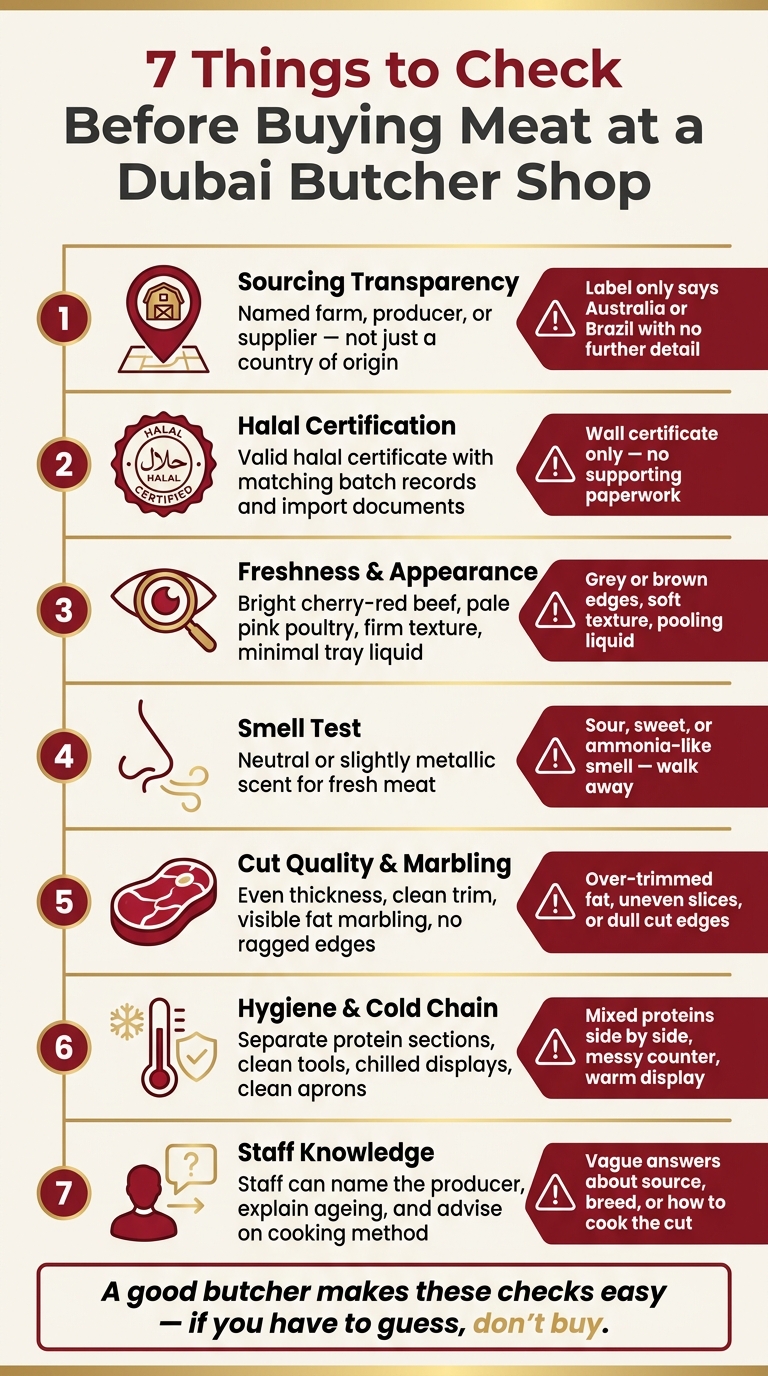
7 Things to Check Before Buying Meat at a Dubai Butcher Shop
What Sets a Good Butcher Shop Apart in Dubai
A good butcher in Dubai is open about sourcing, handling, and halal status. Those three things tell you a lot, fast. Here are the seven signs to check before you buy.
A good butcher answers questions clearly and keeps prep work in plain sight. They should be able to trace each cut back to its source, confirm halal certification when asked, and keep cold-chain control tight in Dubai’s heat. They should also be able to explain the cut, where it came from, and how to cook it in simple terms.
Start with sourcing transparency, because that shapes every other check.
sbb-itb-3031837
1. Sourcing Transparency and Traceability
A butcher shop in Dubai should be able to tell you exactly where each cut comes from. Not just the country of origin, but the named farm, producer, or supplier behind it. If the label only says “Australia” or “Brazil” and nothing more, that’s a gap. You want a clear source you can point to.
Once that source is clear, the next thing to check is halal verification.
The prep area can also tell you a lot. An open-plan setup, where you can watch butchers at work, is a strong sign that the shop has nothing to hide. When handling is visible, it becomes much easier to judge how well the team separates, labels, and prepares meat.
It also helps to ask a couple of direct questions at the counter:
- How often does fresh stock arrive?
- How is the cold chain kept in place from supplier to counter?
Labels should line up with what you see in front of you. That means clear batch details, supplier names, and product labelling that match the meat on display.
Traceability comes first. In Dubai, the next non-negotiable is verified halal certification.
2. Verified Halal Standards and Certifications
In Dubai, halal certification isn't optional. Any premium shop should be able to prove it, not just point to a certificate on the wall. The key is simple: check the certificate, then check the records behind it.
Start with a valid halal certificate, either displayed clearly or shown when you ask. Each cut should also have clear labelling that shows where it came from and its certification status. If the meat is imported, ask to see shipment records and slaughter certification that confirm its halal status before it entered the UAE market.
That matters because paperwork alone isn't enough if handling inside the shop is sloppy. Certified meat should be kept on separate surfaces, prepared with separate tools, and marked with clear labels. When a shop keeps clean halal records, there's less room for doubt, and the premium price makes more sense.
A good counter check is to ask a few direct questions:
- Where did this meat come from?
- Which supplier handled it?
- How do you keep certified stock separate?
If the answers are vague or hesitant, that's a red flag. The shop hasn't done enough to earn your trust.
Once halal compliance is clear, move to what you can judge at the counter: freshness, colour, and aroma.
3. Freshness, Appearance, and Aroma at the Counter
In Dubai’s heat, meat can lose freshness fast. That’s why it helps to judge it at the counter by colour, texture, and smell.
Colour is the first thing to check. Fresh beef should be an even cherry-red, without grey or brown edges. If you spot discolouration around the cut edges, the meat may have been left out too long or kept at uneven temperatures.
Texture and liquid in the tray tell you more. Ask the butcher to show you the cut up close. It should feel firm, not soft or spongy. A little liquid in the tray is normal. But if there’s a lot of visible pooling, that’s a warning sign. It can point to temperature changes during storage.
Then comes the smell. Fresh beef should have a neutral, slightly metallic scent. Fresh chicken should smell neutral too. Any sweet, sour, or ammonia-like smell means the meat is not fresh, no matter how good it looks. Ask to inspect the cut closely.
If the meat clears these checks, the next thing to look at is cut quality.
4. Cut Quality, Marbling, and Butchery Craftsmanship
Once you’ve checked freshness, look at the cut itself. Clean edges, even thickness, and a tidy fat cap usually point to solid butcher work. Ragged edges or uneven slices often mean dull tools or rushed prep. And that doesn’t just change how the meat looks. It can change how it cooks, too.
Once freshness is clear, the cut tells you a lot about the butcher’s skill.
Marbling matters. Those fine streaks of fat running through the meat melt as it cooks and baste the cut from the inside. That helps with tenderness and gives the meat more flavour. A good butcher will trim the outer fat to an even layer without cutting into the marbling below. If a cut looks over-trimmed, some of its worth may already be gone.
The counter is also a good place to test the butcher’s judgment, not just the meat. Ask which cut fits your cooking method, whether you’re grilling or slow-roasting. A clear, direct answer is usually a good sign.
At premium counters in Dubai, you’ll often see beef aged for 45 to 90 days. Dry-aged beef should look darker and feel firmer. That’s normal. If the counter carries dry-aged cuts, ask how long they’ve been aged. A butcher who answers clearly usually knows the product well. After craftsmanship, the next thing to check is whether the shop keeps the same standard in hygiene and storage.
Proper trimming - removing silver skin, excess gristle, or unwanted fat - shows care and can slightly reduce the final weight. That is normal.
5. Hygiene, Handling Practices, and Storage Conditions
Even the best cut can fall apart if the shop handles it badly. Hygiene protects safety and flavour. Skill at the counter doesn't mean much if the basics aren't done right.
Start with what you can see. Check for clean tools, wiped surfaces, clean aprons and gloves, and clear separation between proteins. A butcher's counter that has a separate fishmonger area is a good sign because it helps cut the risk of cross-contamination. If raw chicken and beef are sitting side by side with no clear division, treat that as a red flag.
Cold-chain discipline matters even more in Dubai. Heat changes the stakes. Refrigerated displays should look tidy and properly stocked, with cuts kept on chilled surfaces. Meat also shouldn't be left sitting out any longer than needed.
It also helps to ask a few direct questions. Find out how the meat is stored in the back of house, how temperatures are checked, and how orders are prepared before you buy. When a butcher answers in a clear, specific way, it usually tells you the shop has things under control behind the counter.
Once you've checked the counter, the last thing to look at is the staff's knowledge and confidence.
6. Staff Expertise, Service, and Buyer Confidence
Once the counter clears the freshness and hygiene test, the next thing to watch is the staff. A good butcher doesn’t just pass over a cut and ring up the bill. They walk you through it. In many cases, the gap between buying with confidence and walking away unsure comes down to one thing: how well the person behind the counter answers your questions.
Ask about breed, feeding method, and how the meat was aged. A butcher who knows their craft should be able to explain how ageing changes flavour, tenderness, and even cooking time. If a staff member can clearly break down the difference between a 45-day and a 90-day age, and explain what that means for taste and texture, that’s a strong sign the shop is well run.
It also helps to look for staff who tailor their advice to the cut, the way you plan to cook it, and the meal you’re making. That kind of guidance matters. A steak for a quick pan sear is not the same as one meant for the grill, and a good butcher should speak to that without sounding vague.
Custom preparation is another clear sign of skill. Ask if the butcher can change steak thickness, debone a cut, or portion meat for a certain dish. A shop that handles requests like these shows real butchery skill. It also lowers the odds of wasting an expensive cut because it was prepped the wrong way.
Beyond the technical side, pay attention to how staff speak to you. Clear cooking advice on heat levels, resting times, and seasoning shows the team knows how that cut will behave at home. That same clarity should carry through to sourcing too. If the shop is careful about where its meat comes from, the staff should be able to explain that in plain language.
7. Ethical and Responsible Sourcing in the UAE
Once you've checked staff knowledge, move to the label. That's where ethical sourcing claims should become specific, not fuzzy.
Read the pack closely and look for exact terms like "pasture-raised", "100% grass-fed," or "heritage breed". Those phrases give you something you can check. Vague wording like "natural" doesn't do much. Even "grass-fed" on its own can be hard to confirm without more detail. That gap matters. It's often the difference between a premium claim you can verify and one that sounds good but says very little.
Named producers are another strong sign. If a butcher says the meat comes from a known producer such as Mayura or Rangers Valley, you have a clear trail to follow. You can look up the producer yourself and review its animal welfare practices before buying.
It also helps to know the difference between halal and tayyib. Halal confirms that something is permissible. Tayyib points to a broader standard of ethical quality. In the UAE, shoppers who care about responsible sourcing should look for both, not just one.
The clearest red flag is a vague answer. If staff can't name the producer, explain how the animal was raised and fed, or show welfare records, the sourcing claim is weak.
Sourcing Transparency and Traceability: Side-by-Side Comparison
Traceability shapes flavour, safety, and buyer confidence.
Think of it as a quick sense-check before you ask for any paperwork.
| Factor | Generic Label | Traceable Butcher | What It Means for You |
|---|---|---|---|
| Country of Origin | Broad (e.g., "Australian Beef") | Specific farm or region named | You know where it came from, not just the country |
| Farm / Supplier | Undisclosed or "local supplier" | Named producer or supplier | Accountability is clear, and you can check it yourself |
| Processing Visibility | "Fresh" or "Frozen" with no further detail | Clear ageing and cut details | This can shape tenderness and flavour |
| Halal & Safety Standards | Basic halal claim, no supporting detail | Verified halal certification and batch records | Traceability helps back up the certification claim |
| Buyer Confidence | Depends on appearance only | Full sourcing and handling details | You can make an informed choice instead of relying on a guess |
Once the sourcing looks right, the next thing to check is halal certification.
Halal Certification and Assurance: What to Expect
After traceability, halal assurance is the next thing to check.
Halal proof should be easy to spot at the counter. A butcher you can trust will show current halal certificates and sourcing documents there, not hide them in a drawer or dodge the question. The certificate should match the cut, the supplier, and the batch listed on the label. That gives you proof, not just a promise.
Separate tools and prep areas are standard too. For halal handling, the minimum to expect is simple: dedicated tools and separate prep surfaces for halal stock.
So the baseline is clear:
- Visible halal certificates
- Matching import records
- Separate prep areas
When you visit a butcher, ask to see the halal certificate directly. A compliant shop will show it on request. If the certificate cannot be produced, walk away.
Once the paperwork is clear, judge the meat itself.
How to Read Freshness at the Counter
Once you've confirmed certification, move to the counter test.
Fresh beef should look bright cherry red, while poultry should be pale pink. If you notice dull grey, brown, or greenish tones, that's usually a sign of poor storage or lost freshness. The meat should also feel firm. If it seems soft, overly wet, or slimy, that's a red flag.
Smell gives you the fastest read. Fresh meat should smell neutral or slightly metallic. If the smell is sour, pungent, or close to ammonia, leave it. Simple as that. A little moisture in the tray is normal, but pooling liquid is not.
There is one exception here: intentional ageing. Dry-aged beef is stored for 45 to 90 days or more under controlled conditions, so a darker outer layer is normal in that case.
| What to Check | Good Signs | Warning Signs |
|---|---|---|
| Colour | Bright, consistent | Dull, grey, brown, or greenish |
| Texture | Firm, moist | Soft, wet, or slimy |
| Aroma | Neutral, faintly metallic | Sour, pungent, ammonia-like |
| Tray liquid | Minimal | Pooling or cloudy |
| Fat | Creamy white, firm | Yellowish or oily |
In Dubai's heat, a warm or crowded counter can point to weak cold-chain control.
Once freshness checks out, look at the cut itself.
Craftsmanship, Hygiene, and Service: Premium vs. Average
After you’ve checked freshness, this is a fast way to tell whether you’re looking at a premium butcher or just an average meat counter.
Start with the cuts themselves. Precise trimming and even portioning usually point to real butchery skill. A premium butcher tends to use specialist knives, and that often shows up in cleaner cuts and better texture. Generic blades don’t usually deliver the same level of precision.
Then look at the counter. Premium setups keep proteins separate, tools clean, and chilled displays neat and organised. If the display looks crowded or different proteins are mixed together, that’s a warning sign.
Service matters too. Premium service goes beyond weighing and wrapping. You should get clear advice on the right cut, how to cook it, and how it should be prepared.
The table below sums up the main differences at a glance.
| What to Observe | Premium Butcher | Average Counter |
|---|---|---|
| Trimming | Precise, clean, minimal waste | Basic trimming, with excess fat or silver skin left on |
| Portioning | Uniform thickness across cuts | Inconsistent sizing |
| Tools | Specialist knives | Generic blades |
| Display separation | Distinct sections for different proteins | Shared or mixed displays |
| Staff knowledge | Cooking advice, marbling explanation, provenance detail | Basic weighing and packaging |
Conclusion
A great butcher shop in Dubai doesn’t ask you to just trust it. It shows you the proof - in its certificates, labels, chilled displays, and in the way the staff answer your questions. That’s the difference between a butcher you go back to and one that only sells meat.
These seven checks work best as a set: traceability, halal certification, freshness, craftsmanship, hygiene, staff knowledge, and ethical sourcing. They matter at every price point. Prices change. Standards should not.
FAQs
How can I verify halal proof properly?
Look for formal halal certification first. That’s the clearest sign the meat has been sourced and processed to the required standards.
You can also ask the butcher for documentation or direct confirmation of halal sourcing. A good shop should be able to clearly explain the meat’s origin, certification status, and labelling.
What should I ask a butcher about meat sourcing?
Ask where the meat comes from and whether the butcher can explain its origin in clear, plain terms. You’re not being difficult here. You’re just checking that they know what they’re selling.
It also helps to ask whether the meat is ethically sourced and halal-certified. In the UAE, that last point matters for many shoppers, so it’s worth confirming instead of guessing.
If it fits the cut you’re buying, ask about farming methods too, such as whether the animal was grass-fed or pasture-raised. Then go one step further and ask how the meat was handled after slaughter, including whether it went through any dry-ageing period.
How do I spot poor cold-chain handling?
Check the condition of the meat or fish first. The flesh should feel firm and keep its shape. Skip anything that looks too wet, mushy, or dull in colour.
With seafood, smell tells you a lot. A clean, mild, sea-like scent is usually a good sign. A strong or unpleasant odour can point to age or poor storage.
It also helps to look at how the shop handles fresh stock. Fresh items should be kept separate from frozen or chilled products. And the butcher’s visible hygiene and storage setup should show steady temperature control.


